Geometries of Inner Resonance and Architectures of Transmission in the work of Jeff “KD” Meyers
by Aline Couri
Shape clay into a vessel;
It is the space within that makes it useful.
Cut doors and windows for a room;
It is the holes which make it useful.
Tao Te Ching
Jeff ”KD” Meyers’ work inhabits precisely this invisible zone described by Lao Tzu. While the artist utilizes the precision of technology as substance of light, color, and algorithms, the ultimate purpose of his creation resides not in the physical form, but in the space it opens within the viewer’s perception. KD describes his works as visual koans: paradoxical devices that, much like Zen Buddhist narratives, bypass the analytical mind to facilitate an experience of direct revelation or enlightenment. What is there in the works has the same importance as the voids—of what is not there.
For an artist operating within this architecture of transmission, the words of the visionary Brazilian artist Lygia Clark provide the essential key to understanding this transition from form to experience. “What a form can express only makes sense in close relation to its inner space, the full-emptiness of its existence”; and “the work (of art) should require an immediate participation by the spectator and he, the spectator, should be thrown inside it”. These words provide some essential keys to approach the work of American artist Jeff “KD” Meyers.
In KD’s work, we find a contemporary manifestation of this empty-full. His practice is not a mere exercise in image-making, but a rigorous experiential investigation. Just as Clark’s relational objects were conceived to heal the psychic rift through the body, KD’s work functions as a sacred instrument, a visual technology designed to facilitate a ritual of the gaze.
From Expression to Transmission
KD’s creative process departs from traditional Western notions of artistic expression. KD’s early works as the Yantra Series and the subsequent Plato’s Forms dismantle the hierarchy of the artist-as-creator. He is fascinated and moved by how expanded dimensions of consciousness express themselves. He describes his work as transmission, a state of active listening in which the artist serves as a conduit rather than an author. His series, from the geometric Yantra Series to the digital tapestries of The Secret of Being, emerge through meditation, dreaming, and stillness. This surrender to a higher frequency aligns him with a lineage of receptive artists (Georgiana Houghton, Hilma af Klint, Emma Kunz); yet, his aesthetic is firmly rooted in a sophisticated dialogue with High Modernism and Neoconcretism.
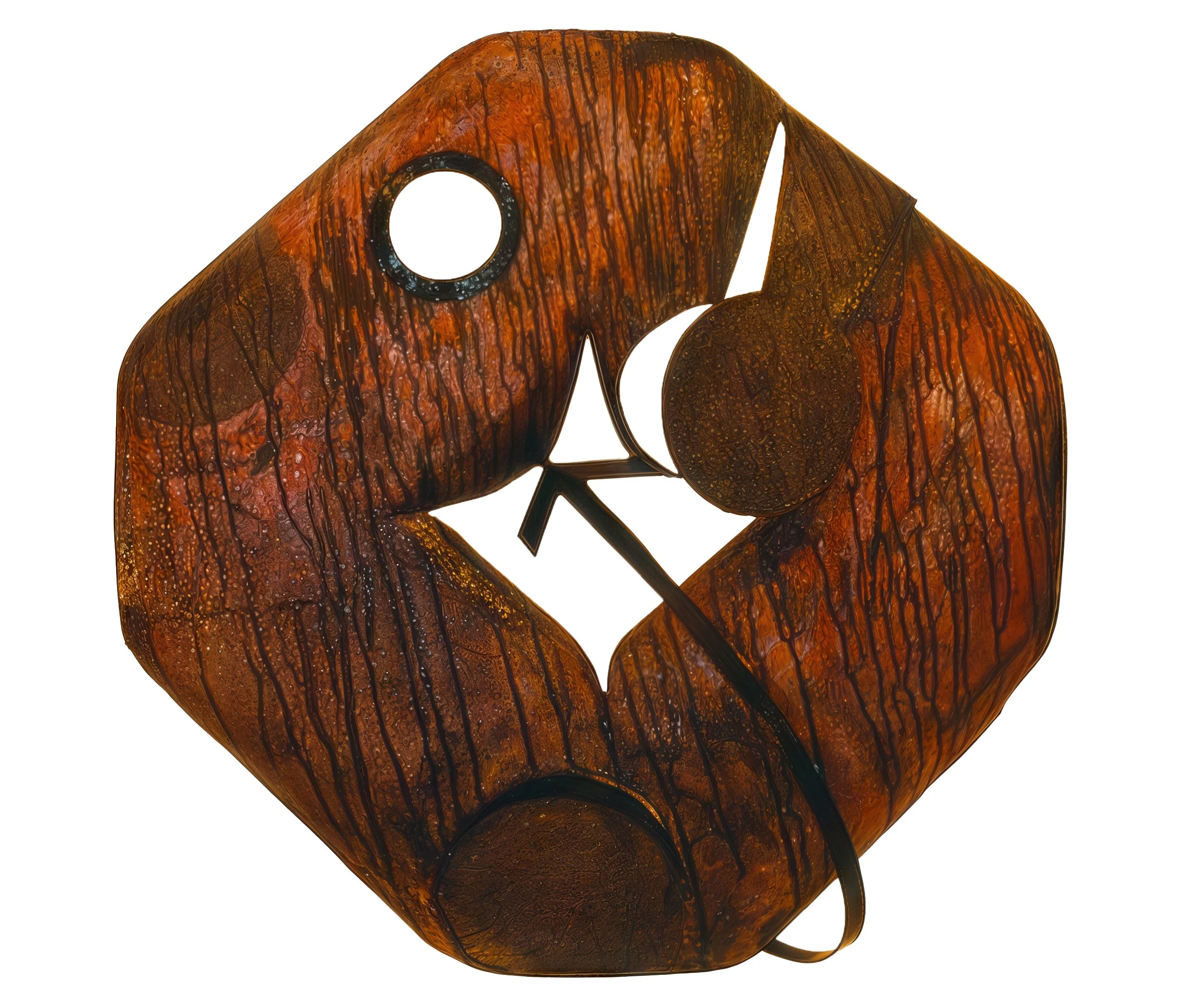
Yantra Series — The Overwhelming Question, 30 x 30 x 8 in. (mixed media on paper)
The word yantra comes from the Sanskrit root yam (to hold, to sustain) and tra (instrument or tool). A yantra is thus a sacred instrument, a device designed to contain, channel, and concentrate energy. Yantras are geometries of inner resonance, a pattern that links the human mind to cosmic principles. By drawing from the structural logic of Hindu yantras and Tibetan mandalas, KD creates power objects and mystical diagrams designed to channel and concentrate energy. By listening, rather than creating, KD aligns his process with the spiritual goal to recognize inherent unity.
In the contemporary landscape where the digital often serves as a tool for acceleration and detachment, KD’s practice emerges as a profound counter-narrative, a ritual of seeing that seeks the sacred within the virtual. In The Secret of Being Series (digital collages and large-scale prints created in collaboration with American artist Jody Smith), these large-scale digital collages function as contemporary yantras, born through technology but pointing resolutely beyond it. By utilizing layering, repetition, and transparency, they treat the digital signal as a living vibration. The Common Sacred manifests here as an algorithmic mantra, where the code itself becomes a form of prayer, and the screen becomes a "digital flesh" that touches a non-material reality. Those large print images relate to some of the poetics of Lucas Samaras–infinite, fragmented spaces, built upon KD’s image in yoga poses as the basis of iteration–as if photo-transformations create mirrored mandalas, as a spiritual confrontation with the multiplicity of the self.
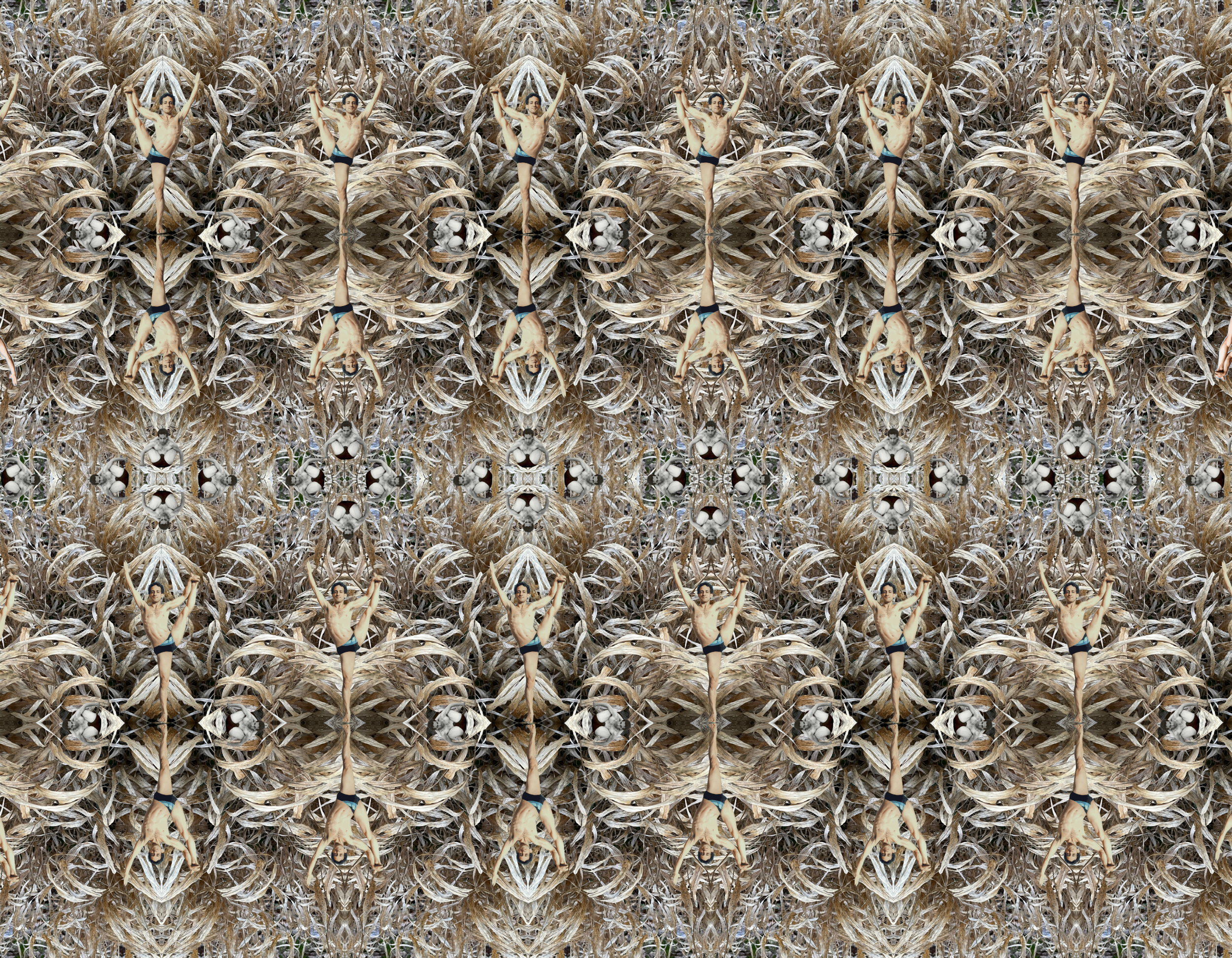
The Secret of Being Series — 2025 digital collage/giclée
Like a Gertrude Stein poem where the repetition of form generates a new reality, KD’s use of pattern and algorithmic mantra insists on the persistence of magic in the everyday. He offers the viewer not just an image to look at, but an altar to inhabit, a digital and physical architecture of devotion designed for the healing of the planet.
In this architecture of transmission, KD’s work revives what Gilbert Simondon defined as the magical phase of thought: a primordial state in which the object is not a cold tool, but a key point of concretization of the pre-individual that structures the world and mediates the sacred. By using digital technology to create visual sutras, he builds with the pixels a web of light where technology becomes the very medium of a new spiritual gravitation.
If Brazilian artist Ernesto Neto conceived his Naves as a “hypothetical idealization of the body as a self-sufficient universe”, KD uses technology to create digital temples, using transparency and digital repetition to establish a primal unity between the observer and the infinite. KD’s artworks operate precisely within this magical realm. They are not mere decorative representations; they are mediating technologies that transform the digital into a field of vibrating forces. Just as Neto builds the collective body, KD uses technique to reestablish this primitive unity. His “visual sutras” function as Simondon’s key points: sites of high energetic intensity that allow the viewer to bypass the analytical mind and access Clark’s vibrating body. For KD, a work of art is not a static object, but a mediator of the sacred.
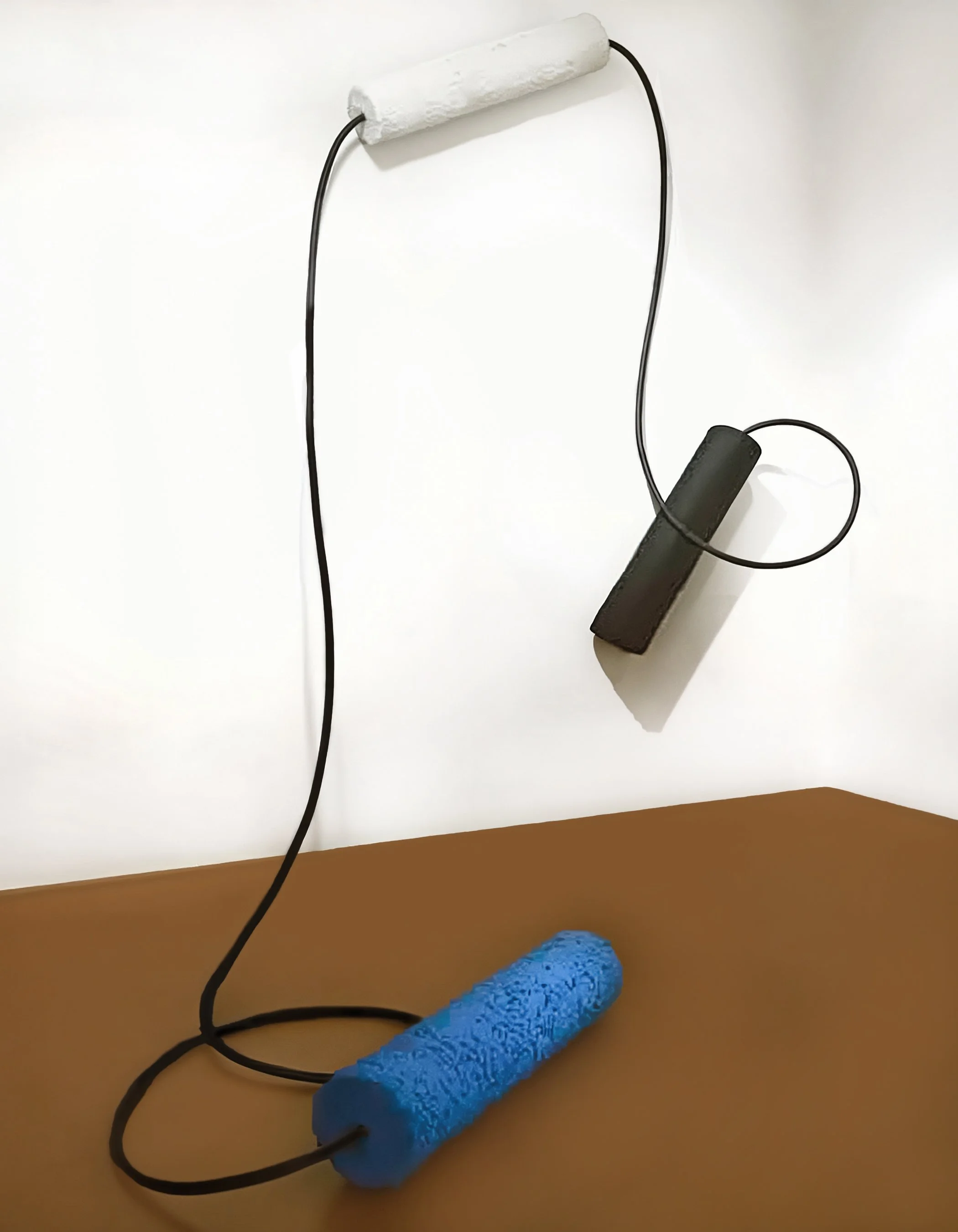
Plato’s Forms Series — Delphic Oracle (acrylic on mixed media)
The visual power of KD’s work lies in a rigorous synthesis between Neoplasticism and the spiritual tension of Mannerism. His spirituality seems to have an analytical and structural language, showing some roots in the Neoplasticism of Piet Mondrian. Immutable laws of the universe can be found in all that is seen and felt in nature which veils the true spiritual reality.
KD adopts Mondrian’s quest for universal balance through the pure relationship of lines and colors. However, he subverts the static grid by infusing it with the supernatural luminosity of Mannerism, a manifestation of divine grace or psychological intensity. Where Neoplasticism sought absolute order, KD introduces the irrational space typical of Mannerist masters. In his compositions, forms seem to contract into a kind of digital serpentine figure that spiral of tension which, in art history, signaled the passage from the material world to mystical ecstasy.
By fusing the structural rigor of the grid with this sacred instability, KD creates what he defines as “religious art for beliefs that do not yet exist” offering his work as an object of power for the soul’s journey. He installs a space where the Divine Feminine and the pleasures of the spirit become tangible through the luminous matter of our time.
In the tradition of Bill Viola’s slow-motion transfigurations or Mark Rothko’s luminous chapels, KD’s work insists on stillness. It is an invitation to transition from the chaos of the everyday into a space of dynamic equilibrium. Whether through the physical grain of a wall sculpture or the flicker of a digital sutra, these works serve as altars for present-future age, not to worship a distant deity, but to recognize the sacred energy within the little things of everyday life and the collective body of all beings. KD does not merely show us a vision; he constructs a system of vibrational fields where the viewer is invited to participate in the act of manifestation itself.

Oracle Series — 2026 Eurydice (acrylic on mixed media)
In this realm, KD does not depict the world: he creates possible worlds, whose internal logic echoes both mathematics and mantra. In our individualistic, fast-paced, and materialistic age, KD’s works invite us to slow down, to contemplate, and to connect with what lies beyond what we can only physically see.
Aline Couri is Associate Professor of Art & Media History and Technologies at the Federal University of Rio de Janeiro (UFRJ).